

This is the single most common question we field from first-time charterers, and it usually arrives in some version of: “We’ve seen photos of both, they both look great, what’s actually different?” It’s a fair question, because online listings rarely explain it well — they show beautiful interiors and call it a day.
We operate both vessel types from our Fethiye shipyard, so this isn’t a comparison written to push you toward one or the other. It’s the same explanation we give guests on the phone before they book.
The Core Difference: Hull Design
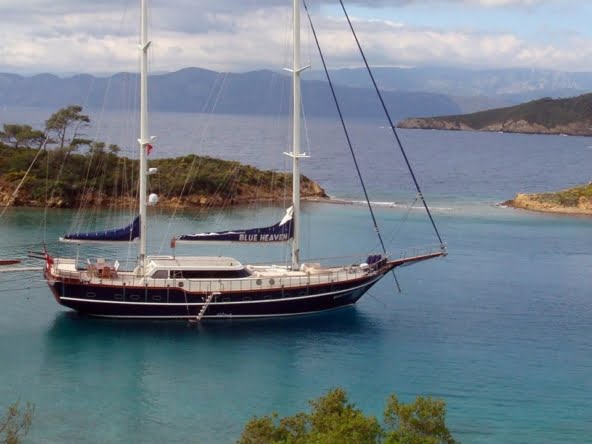
A gulet is a traditional wooden monohull — one hull, broad-beamed, built from a design lineage stretching back to Aegean working boats. A catamaran has two parallel hulls connected by a wide deck structure, a design that originated for entirely different reasons but converges with the gulet on one major advantage: stability.
That shared stability is why these two vessel types get compared so often, even though almost everything else about them differs.
Stability and Motion at Sea
This is usually the deciding factor for families and anyone prone to seasickness.
A catamaran’s twin-hull design makes it exceptionally resistant to rolling. Because the boat’s weight is distributed across two hulls rather than concentrated in one, catamarans sit flatter in the water and barely rock at anchor — a real advantage for guests who get queasy on conventional boats.
A gulet’s wide beam gives it strong stability too, though it doesn’t quite match a catamaran’s flatness. Gulets do roll somewhat at anchor in choppy conditions, though far less than a narrow sailing yacht. For most guests in typical Aegean summer conditions, this difference is barely noticeable. For anyone with a known sensitivity to motion, a catamaran has the edge.
Space and Layout
Here the comparison flips in the gulet’s favor, depending on what kind of space you value.
A gulet’s deck is fundamentally social — one continuous, open area at the stern designed around shared dining and lounging. Everyone tends to end up in the same place, which suits groups who want to be together.
A catamaran’s layout is more compartmentalized. The bridge deck (the area between the hulls) provides communal space, but cabins are distributed across both hulls, creating more separation between groups. This suits families or multi-generational charters who want some built-in privacy — grandparents in one hull, grandchildren and parents in the other, for instance.
Below deck, catamaran cabins are often slightly more modern in finish, since most charter catamarans are newer-built fiberglass vessels. Gulet cabins, particularly on higher-specification builds like our own, combine traditional wood interiors with contemporary fittings — the aesthetic is different even when the comfort level is comparable.
Sailing Character and Speed
A catamaran generally sails faster and points higher into the wind than a gulet, which matters if covering more nautical miles per day is a priority. Catamarans are also simpler to handle under sail due to their stability, which is part of why bareboat (skipper-it-yourself) catamaran charters are common in some parts of the world — though in Turkey, virtually all charters, gulet or catamaran, come with a professional crew regardless.
A gulet moves at a more deliberate pace, typically 8 to 10 knots, and spends more of its cruising time under engine rather than sail, with sails raised when conditions are right rather than as the primary mode of propulsion. The experience is unhurried by design — covering less distance is the trade-off for the slower, more atmospheric pace many charter guests are actually looking for.
Price Comparison
Catamarans of comparable cabin count to a standard gulet typically run somewhat higher in charter price, largely because of higher build and maintenance costs for the composite hulls and twin-engine configuration. A 4-cabin catamaran and a 4-cabin gulet are rarely identical in price; the catamaran tends to sit at the upper end of that comparison.
That said, pricing varies enormously by vessel age, specification, and season, so this is a general tendency rather than a fixed rule. We can provide exact comparative quotes for specific vessels in our fleet on request.
Which Type of Group Suits Each Vessel
A gulet tends to suit: groups who want a unified social experience, anyone drawn to traditional wooden boat character, guests planning to spend most of the trip swimming and relaxing rather than covering long distances, and charters where the atmosphere of the vessel itself matters as much as the destination.
A catamaran tends to suit: families with members prone to seasickness, multi-generational groups wanting built-in privacy between cabins, charters prioritizing a smoother ride above all else, and guests who want a more contemporary aesthetic.
Neither vessel is the “correct” choice in absolute terms. We’ve had repeat guests who charter a catamaran one year and a gulet the next, specifically because they wanted a different kind of trip.
What We Recommend Asking Yourself
Before deciding, it helps to answer a few honest questions: Does anyone in your group get seasick easily? Do you want everyone together in one space, or some built-in separation? Does the traditional wooden-boat atmosphere matter to you, or are you indifferent to it? And finally, are you optimizing for covering more ground, or for a slower, anchorage-focused trip?
Most groups land on an answer within a few minutes of talking through these points, and we walk through exactly this with every new charter inquiry.
Frequently Asked Questions
Is a catamaran always more stable than a gulet?
At anchor, generally yes. Underway in rough conditions, both vessel types handle Aegean summer weather well, but a catamaran’s twin-hull design gives it a flatter ride in most situations.
Are catamarans more expensive to charter than gulets?
Often somewhat, for comparable cabin counts, though this varies by specific vessel, age, and season. We can provide direct comparisons for vessels in our fleet.
Can children get just as much fun on either vessel?
Yes. Both vessel types are well-suited to families; the main practical difference is the seasickness factor and how cabin space is distributed.
Do gulets and catamarans follow the same routes?
Largely yes — most Turkish Riviera routes, from short Fethiye loops to extended voyages into Greek waters, work for either vessel type, though catamarans can cover slightly longer distances per day if a route requires it.
Which is better for a honeymoon or small couple’s trip?
Either works well, though smaller sailing yachts or smaller gulets are also worth considering for couples specifically, since both vessel types in this comparison are generally built for larger groups.
Can I see both types before deciding?
Yes. We’re happy to share photos, layouts, and availability for both gulets and catamarans in our fleet so you can compare directly before booking.
Talk to Us About Your Charter
Albatros Yachting operates both gulets and catamarans from our own shipyard and fleet in Fethiye, Turkey, and we’re glad to walk through the right choice for your specific group.
Fevzi Çakmak Cd. No:11, Yat Limanı, Fethiye, Turkey
Phone: +90 4447405
Email: info@albatrosyachting.com
Web: albatrosyachting.com
For European inquiries: our offices in Madrid, Spain and Germany are available in your local time zone.
Albatros Yachting is a member of TYBA (Turkish Yachting and Boating Association). All vessels operate under Turkish Maritime Authority certification.